Key Takeaways:
- Platform Evolution: Systems are moving from simple approval workflows to integrated academic operations platforms.
- Sustained Growth: The curriculum management market continues expanding through the convergence of curriculum, catalog, and scheduling.
- Data-Centric Strategy: Institutions now prioritize structured data over forms to optimize enrollment and resources.
For decades, curriculum management systems lived in the shadows of the “big” campus tech like the LMS or SIS. They were viewed primarily as back-office utilities—the digital equivalent of a filing cabinet and a rubber stamp. These tools digitized paper forms, routed approvals through the necessary channels, and helped institutions move proposals from one committee to another with slightly more speed. However, that narrow definition is rapidly dissolving. Based on current institutional trends and the latest 2026 data from ListEdTech, we are witnessing a meaningful evolutionary shift: curriculum management is graduating from a mere workflow tool to become the foundational platform layer for all academic operations.
The Growth Paradox: Why The Curriculum Market Isn’t Boring
When observers look at mature categories in higher education, such as Learning Management Systems (LMS) or Student Information Systems (SIS), they expect a predictable “slow-down.” These markets usually feature slowing growth, aggressive vendor consolidation, and a limited number of new implementations. Interestingly, the curriculum management space is bucking this trend entirely. When we look at the combined market of curriculum, catalog, and scheduling systems, the number of institutions adopting these solutions has steadily increased. New implementations remain consistently strong, even in an era of budget scrutiny. This suggests a category that is still actively expanding and reinventing itself rather than reaching a point of stagnation.
At the Same Time, the Market Is Fragmented
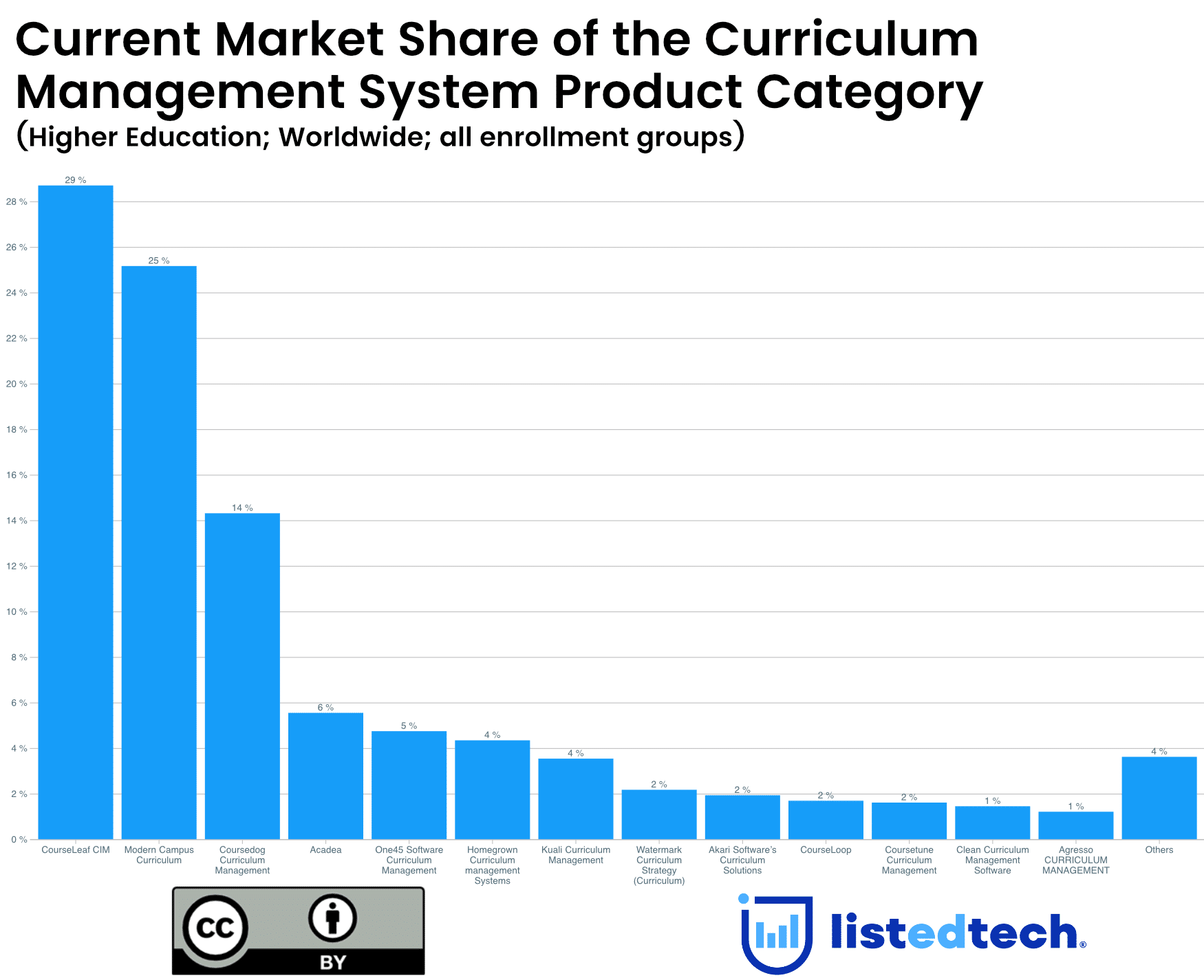
While adoption is scaling, the vendor landscape remains remarkably fragmented—a rarity in modern EdTech. According to our recent data, the market is characterized by a “heavy at the top, long at the tail” distribution. CourseLeaf CIM leads the pack with a 29% market share, followed by Modern Campus Curriculum at 25%. Coursedog holds a significant 14% share, but beyond these top three, the drop-off is steep. Most other vendors sit in the 2% to 4% range, and a persistent “long tail” of smaller solutions and homegrown systems continues to exist.
This combination of high fragmentation and sustained adoption is unusual. Typically, high fragmentation suggests an early-stage market where no one has figured out the “winning” formula. But here, we see scale and maturity coexisting with a crowded field. This indicates that the space isn’t just crowded; it is being actively redefined in real-time by institutions that are no longer satisfied with “good enough” legacy tools.
Beyond the Approval Stamp: Managing Data, Not Just Forms
Historically, curriculum systems were designed to solve a clear, administrative headache: standardizing governance and improving the efficiency of program approvals. They treated the curriculum as a process to be managed. That core assumption is now being challenged by institutions asking more complex, interconnected questions. Modern provosts and registrars no longer just want to know if a form was signed; they want to know how a curriculum change impacts enrollment, where program bottlenecks are hiding, and how a new course connects directly to the available room schedule.
These are data questions, not workflow questions. Answering them requires systems that can structure and connect disparate data points across the institution rather than just routing a digital folder from point A to point B.
Dig Deeper: The Data Behind the Stories
Stop reading and start digging into the data on our portal.
Analyze Curriculum Management, Catalog Management, and Learning Management metrics.
Master Student Information and Scheduling – Room Management.
Go beyond the blog—get the facts that drive decisions.
Growth Through Convergence
The expansion of this market is not happening in a vacuum. Instead, it is being driven by the collision of three historically separate categories: curriculum management, catalog management, and scheduling. This growth is being fueled by convergence, not just simple system replacement. As these functions merge, institutions are moving away from isolated tools in favor of a unified approach characterized by:
- Shared data models that ensure a single version of truth across all academic departments.
- Connected workflows that eliminate the silos between faculty governance and registrar scheduling.
- Cross-functional visibility that allows leaders to see the downstream impacts of curriculum changes (like faculty load or room availability) before they are finalized.
The Emergence of the Academic Operations Platform
As these categories converge, a new “platform layer” is forming. This layer acts as the central nervous system for academic operations, connecting curriculum and catalog with scheduling, and increasingly, with student outcomes and analytics. Instead of relying on a patchwork of disconnected software, institutions are gravitating toward these platforms to gain a holistic view of their offerings. This shift allows departments that rarely spoke to one another to finally work from the same playbook, transforming the curriculum from a static document into a dynamic operational asset.
Why This Matters for the Future
This evolution helps explain both key signals in the data. First, the market remains fragmented because institutions are entering this space from different starting points. Some begin with curriculum, while others prioritize scheduling or catalog needs. Second, the market continues to grow because this is not just a replacement cycle. It is an expansion into entirely new use cases, such as academic planning, resource optimization, and student success analytics.
Final Thought
Individually, a curriculum management system might appear to be a niche tool. However, when viewed alongside catalog and scheduling functions, a different picture emerges: a growing market with a converging set of capabilities. We are not looking at a mature, stagnant category, but rather an emerging platform. What used to be a simple workflow tool is becoming the essential foundation for how modern institutions structure, manage, and optimize their entire academic offering.